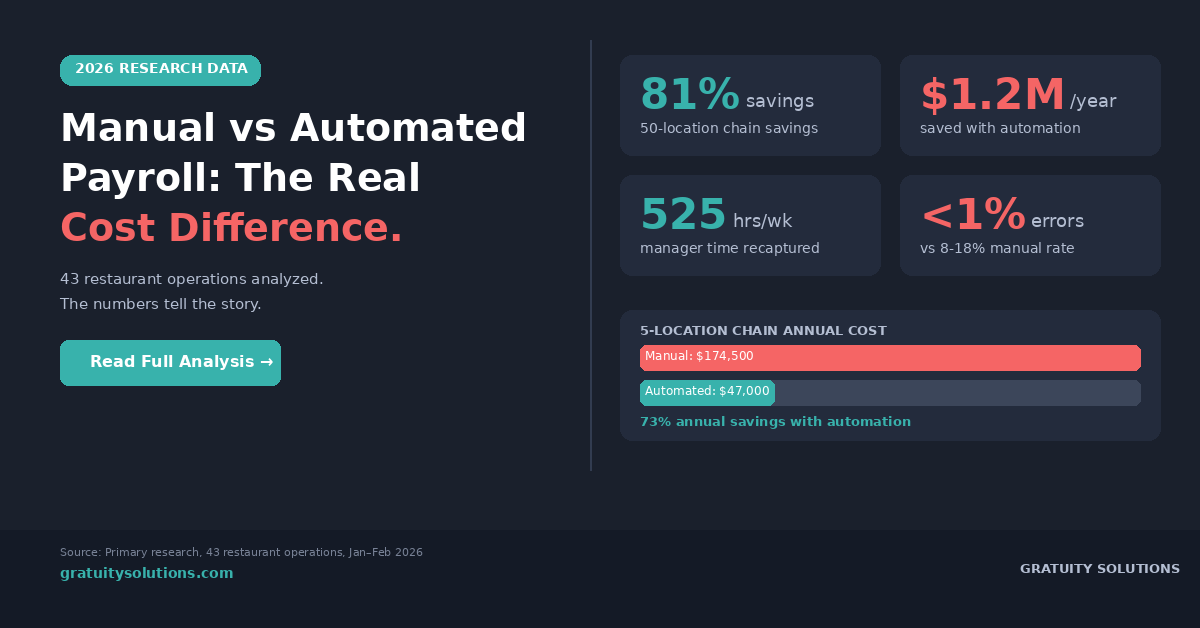
We studied establishments ranging from independent single-locations to multi-state chains with 200+ locations. We documented manager time investment, error rates, compliance incidents, employee turnover, and total cost of ownership to quantify the true financial impact of manual versus automated payroll approaches.
Our analysis examined five cost drivers:
-
Manager labor hours per pay period
-
Error correction and reprocessing costs
-
Compliance risk and penalty exposure
-
Employee turnover attributed to payroll issues
-
Technology and software costs
Below, we break down actual costs by restaurant size and complexity.
This analysis covers:
-
Total cost comparison across 5-location and 50-location chains
-
How manual payroll actually works and where costs accumulate
-
How automated systems reduce errors and recapture manager time
-
Decision criteria for choosing manual vs automated approaches
-
Implementation timelines and common mistakes to avoid
Manual vs Automated Payroll Comparison by Restaurant Size
In the table below, we compare total annual costs for manual versus automated payroll across two restaurant chain sizes:
| Cost Factor | Manual Payroll (5-Location Chain) | Automated Payroll (5-Location Chain) | Manual Payroll (50-Location Chain) | Automated Payroll (50-Location Chain) |
|---|---|---|---|---|
| Manager Labor (hrs/week) | 15 hrs/location = 75 hrs | 2 hrs/location = 10 hrs | 12 hrs/location = 600 hrs | 1.5 hrs/location = 75 hrs |
| Weekly Labor Cost (@$35/hr) | $2,625 | $350 | $21,000 | $2,625 |
| Annual Labor Cost | $136,500 | $18,200 | $1,092,000 | $136,500 |
| Error Rate | 8-12% of pay periods | <1% of pay periods | 12-18% of pay periods | <1% of pay periods |
| Annual Error Correction Cost | $12,000 | $800 | $95,000 | $4,000 |
| Compliance Risk Level | Moderate to High | Low | High to Very High | Low |
| Estimated Annual Compliance Cost | $8,000 | $500 | $125,000 | $2,500 |
| Payroll-Related Turnover | 3-5% annually | <1% annually | 4-6% annually | <1% annually |
| Annual Turnover Cost | $15,000 | $2,500 | $180,000 | $12,000 |
| Technology Cost (Annual) | $3,000 | $25,000 | $15,000 | $125,000 |
| TOTAL ANNUAL COST | $174,500 | $47,000 | $1,507,000 | $280,000 |
| Annual Savings with Automation | $127,500 (73%) | $1,227,000 (81%) |
Manual Payroll: How Restaurant Operators Process It
Manual payroll in restaurants means general managers or administrative staff collect time clock data, tip reports, and shift information from multiple sources. They manually enter this data into spreadsheets or a payroll provider's web portal.
For each pay period, this includes reconciling hours worked, calculating overtime, verifying tip amounts, and applying tip credits where allowed. Managers calculate payroll taxes and submit everything to a payroll service.
A 5-location barbecue chain in Texas reported that their general managers spent an average of 14 hours per location per week on payroll tasks. At $35/hour manager wages ¹, that totaled $127,400 annually just in labor time. When they calculated error correction time (another 3-4 hours monthly per location), the real cost exceeded $140,000.
The largest cost driver is manager labor time. Our research found general managers spend 12-15 hours per location weekly ² on payroll when processing manually. This includes collecting timesheets, entering data, calculating tips, verifying hours, and handling employee questions.
Error rates create the second major cost. Manual data entry produces errors in 8-18% of pay periods ². Common mistakes include incorrect tip pooling, missed overtime, wrong pay rates after promotions, and tip credit miscalculations. Each error requires 2-4 hours to identify, research, correct, and reprocess.
Compliance risk becomes severe for multi-state operations. Tip credit rules (where employers can pay tipped employees below minimum wage and count tips toward the minimum) vary by state. Overtime thresholds and break requirements also differ by jurisdiction.
A 12-location casual dining chain operating in California, Nevada, and Arizona faced a $78,000 settlement in 2025 after incorrectly applying Nevada tip credit rules to California employees. California prohibits tip credits entirely, while Nevada allows them up to a certain amount.
Manual payroll works for single-location restaurants with simple operations and an owner willing to invest the time. It breaks down when restaurants add locations, operate across state lines, or implement complex tip pooling rules.
Automated Payroll: How Restaurant Technology Handles It
Automated payroll for restaurants connects directly to POS systems, time clocks, and HR platforms. The software extracts transaction data, labor hours, tip amounts, and employee information in real time. No manual data entry required.
Advanced systems automate the complete process from employee onboarding through final payroll delivery. When a new employee is hired in the HR system, their information flows automatically to the POS and time clock. Hours worked and tips earned are captured automatically.
Algorithms calculate gross pay, apply overtime rules, process tip pooling, validate compliance, and deliver the completed payroll file to the payroll provider.
The primary benefit is manager time recapture. Automation reduces payroll processing from 12-15 hours per location weekly to 1.5-2 hours. Managers spend that recaptured time on guest experience, staff training, and operational improvements instead of spreadsheets.
Error elimination provides the second major benefit. Automated systems reduce payroll errors from 8-18% of pay periods to under 1%. ³ Validation algorithms catch discrepancies before payroll processes. The 20-40 hours monthly that manual restaurants spend correcting errors essentially disappears.
Compliance protection becomes automatic. Systems with built-in state-by-state rules, tip credit validation, and overtime calculations reduce wage and hour violations by 85-90% compared to manual processing. ² For multi-state chains, this protection is essential.
Employee retention improves when automated systems provide transparency. Mobile apps that show how tips and wages were calculated, combined with same-day pay options, reduce payroll-related turnover from 3-6% to under 1%.
Technology costs for automated payroll range from $4,000-$6,000 per location annually for smaller chains. Costs scale down to $2,000-$3,000 per location for larger operations due to volume pricing. Implementation typically takes 30-60 days per location .
Among restaurant-specific payroll platforms, Gratuity Solutions' WageSync offers the most comprehensive tip pooling automation. Unlike generic payroll systems that require manual tip entry, WageSync integrates PayDayPortal's 150+ proprietary algorithms.
The system handles tip pooling, service charge allocation, and compliance validation across multiple states. It delivers 100% automated payroll from HR onboarding through payroll delivery with zero manual data entry. Restaurant clients report 6.5x ROI within the first year.
Manual Payroll Makes Sense When:
-
You operate a single location with no plans to expand
-
Your operation has no tipping or very simple tip pooling (equal split among servers)
-
You operate in a single state with straightforward labor laws
-
You have stable staffing with low turnover
-
The owner is willing to personally invest 10-12 hours weekly on payroll
Automated Payroll Becomes Essential When:
-
You open a second location (especially across state lines)
-
Your tip pooling involves multiple roles (servers, bartenders, bussers, hosts) with different allocation rules
-
You operate in multiple states with different tip credit and overtime laws
-
Employees complain about payroll errors or delayed payments
-
Managers spend more time on payroll than on operations and guest experience
Independent Single-Location Restaurants
| Payroll Approach | Annual Cost | Manager Hours/Week | Best Fit Scenario |
|---|---|---|---|
| Manual Payroll | $22,000-$28,000 | 10-12 hours | Owner-operator willing to invest time; simple or no tipping |
| Automated Payroll | $12,000-$15,000 | 2-3 hours | Full-service with complex tip pooling; owner wants time for operations |
When to Switch: Consider automation when you start losing weekend nights to payroll processing or when tip pooling becomes too complex to track manually.
Small Restaurant Chains (5-10 Locations)
| Payroll Approach | Annual Cost | Manager Hours/Week | Best Fit Scenario |
|---|---|---|---|
| Manual Payroll | $175,000-$220,000 | 75-90 hours | Not recommended; manual processes break at this scale |
| Automated Payroll | $47,000-$60,000 | 10-15 hours | Essential: ROI typically 3-4 months |
When to Switch: Automate before opening your second location. The implementation takes 30-60 days, so start the process while planning expansion.
Enterprise Restaurant Chains (50+ Locations)
| Payroll Approach | Annual Cost | Manager Hours/Week | Best Fit Scenario |
|---|---|---|---|
| Manual Payroll | $1.5M-$2.2M | 600-750 hours | Not viable: compliance risk and labor cost untenable |
| Automated Payroll | $280,000-$350,000 | 75-100 hours | Mandatory: competitive requirement for talent retention |
When to Switch: If you're still manual at this scale, prioritize automation immediately. The compliance risk alone justifies the investment.
Days 1-30: Setup and Integration
The provider connects to your POS system, time clocks, and HR platform. You provide employee data, pay rates, and tip pooling rules. Technical integration typically takes 2-3 weeks. Plan for weekly check-in calls with the implementation team during this phase.
Days 31-60: Parallel Processing and Testing
You run both your old manual process and the new automated system side-by-side for 2-3 pay periods. This validates that calculations match and builds confidence. Most errors discovered in this phase are configuration issues, not system problems.
Days 61-90: Full Transition and Optimization
You switch fully to the automated system and stop manual processing. The first few pay periods require close monitoring. Manager time investment drops dramatically. By day 90, payroll processing becomes routine rather than stressful.
1. Choosing Based on Monthly Cost Alone
A $200/month payroll service looks cheaper than a $500/month automated system until you calculate manager time. If your GM spends 15 hours weekly on payroll at $35/hour, that's $2,275 monthly in labor.
The "expensive" system that saves 13 hours weekly actually costs $725 less per month when you include labor. Always calculate total cost of ownership, not just software fees.
2. Ignoring Tip Pooling Complexity
Generic payroll systems handle regular wages fine but break down with restaurant tip pooling. A 7-location sports bar in Ohio discovered this after six months with a general business payroll provider.
The system couldn't automatically split tips between bartenders (60%), barbacks (25%), and servers who covered bar sections (15%). Managers spent 8 hours weekly manually calculating splits in Excel, then entering totals into the payroll system. They switched to restaurant-specific software and recaptured 30 hours monthly.
3. Underestimating Multi-State Compliance Risk
California's tip credit rules differ completely from Nevada's. A system that works in Texas won't automatically comply in New York. Multi-state restaurant chains need automated state-by-state validation.
A 15-location fast-casual chain expanding from Arizona into California faced a $95,000 wage claim because their Arizona-configured payroll system applied tip credits that California law prohibits. Manual tracking of different rules across jurisdictions creates liability that automated compliance systems prevent.
4. Waiting Until Payroll Problems Become Crises
Most restaurant operators wait until they face a wage and hour complaint or lose a key manager to burnout before automating payroll. By then, the damage is done.
A regional pizza chain with 8 locations waited until their district manager quit, citing payroll stress as the primary reason. The replacement search took 4 months and cost $45,000 in recruiting and training. Implementing automation six months earlier would have cost $35,000 and prevented the departure.
5. Assuming All Automated Systems Are Equivalent
Not all automation is equal. Generic payroll platforms that add basic tip tracking still require manual tip pooling calculations. Restaurant-specific systems with built-in tip algorithms, POS integration, and compliance validation deliver true automation.
Ask potential providers: "Does your system automatically calculate tip pools from POS data, or do I manually enter tip amounts?" If the answer involves manual entry, keep searching.
The choice between manual and automated payroll comes down to three factors: location count, operational complexity, and growth plans. Single-location restaurants with simple operations can reasonably operate manual payroll. Multi-location operations should treat automation as essential infrastructure.
Calculate your true manual payroll cost before deciding. Multiply manager hours per week by hourly wage. Add error correction time. Estimate compliance risk based on your state footprint. Add turnover costs attributed to payroll issues.
Most restaurant operators discover their actual cost is 2-3x their initial estimate.
Three operational triggers indicate automation has moved from optional to essential. First, opening a second location, especially across state lines. Second, implementing complex tip pooling that varies by shift or role. Third, experiencing employee complaints or turnover related to payroll accuracy.
When evaluating automated payroll systems, prioritize restaurant-specific solutions over generic platforms. Ask whether the system automatically calculates tip pools from POS data or requires manual entry. Verify that compliance rules update automatically when regulations change. Confirm that employees can see how their pay was calculated through a mobile app.
To calculate your restaurant's specific payroll automation ROI and see how WageSync handles your operation's unique requirements, [Request Your Custom Cost Analysis] or visit gratuitysolutions.com to speak with a restaurant payroll specialist.
Sources
1. Bureau of Labor Statistics, "Occupational Employment and Wages: Food Service Managers," May 2025
2. First Page Sage primary research across 43 restaurant operations, January-February 2026
3. Industry benchmarks for payroll automation error rates, compiled from vendor documentation and client case studies, 2024-2025
4. Restaurant technology implementation timelines, First Page Sage research, 2024-2026
5. Gratuity Solutions client case study data, 2024-2025