
DOL’s New “Dual Jobs” Regulation Changes How Tipped Employees Get Paid
Read MoreThe real problem isn't tipping itself. It's a broken system that frustrates diners and destabilizes your workforce.
The no-tip restaurant model is back in the headlines. A recent Fox News report highlighted the growing divide: some operators are ditching gratuities entirely and baking labor costs into menu prices, while others warn that eliminating tips will erode the service quality that sets their restaurants apart.
Both sides have a point. And both are responding to the same underlying problem — a tipping system that has become confusing, inconsistent, and increasingly resented by the very guests it's supposed to serve.
But here's what the no-tip debate misses: you don't have to choose between a broken tipping model and no tips at all. There's a third option, and it's the one that actually protects your margins, your service standards, and your team.
Tip Fatigue Is Real — and It's Hurting Your Business
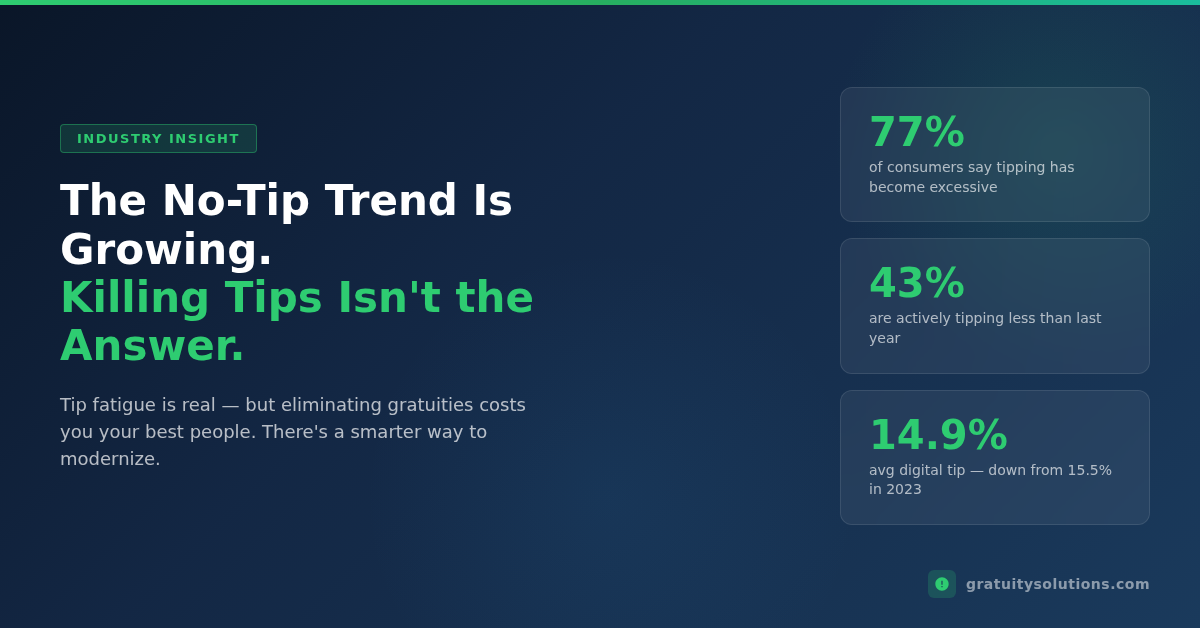
The numbers tell a clear story. According to Popmenu's 2025 annual study, 77% of consumers now say tipping culture in the U.S. has become excessive. Two-thirds report feeling fed up with tipping altogether — up from 53% just two years earlier. And 43% say they're actively tipping less than they used to.
This isn't just consumer sentiment. It's showing up in the data that hits your bottom line. Average tips on digital food and beverage transactions dropped to 14.9% in Q2 2025, down from 15.5% in 2023. Just 35% of Americans now say they typically leave 20%, compared to 37% the year before.
What's driving the decline? It's not that people have suddenly decided servers don't deserve to be compensated well. It's that the experience of tipping has become adversarial. Consumers report being prompted to tip an average of ten times per month across various establishments. Sixty-six percent feel pressured by digital payment screens suggesting gratuity amounts, especially when staff are watching. And 64% admit they've tipped out of guilt after receiving poor service — not because they wanted to, but because the system made them feel they had to.
When tipping feels like an obligation rather than a reward, everyone loses. Diners resent the check. Servers lose the connection between great work and great pay. And operators are stuck in the middle, watching trust erode on both sides.
This is exactly the gap that modern gratuity management platforms like Gratuity Solutions are designed to close — but more on that in a moment.
The No-Tip Argument: Understandable, but Risky
Some operators are responding by removing tips from the equation entirely. Joseph Magidow, chef and owner of La Cigale in San Francisco, told Fox News that his restaurant builds labor costs directly into menu prices, describing it as a more transparent experience for guests. He argues that the traditional tipped model creates unpredictability and misaligned incentives for workers.
There's logic there. A fully inclusive pricing model eliminates the awkward checkout moment, simplifies payroll, and — in theory — gives every team member a predictable, stable income.
But other operators see serious problems with the approach. Vicki Parmelee, owner of Jumby Bay Island Grill in Jupiter, Florida, pushed back in the same Fox News report, warning that removing tips eliminates the incentive for servers to go above and beyond. Without that direct connection between effort and earnings, she argues, service levels degrade.
The data supports her concern. Hospitality is one of the few industries where frontline workers have a direct, real-time feedback loop with customers through gratuities. That loop drives attentiveness, personalization, and hustle — the things that separate a forgettable meal from one that earns a five-star review and a repeat visit.
Removing tips also creates practical challenges that rarely make the headlines. Menu prices go up 18–22% to absorb the labor cost, which can trigger sticker shock even when total spend stays the same. Top-performing servers — the ones who consistently earn well above average — often leave for tipped establishments where their skills translate directly into higher pay. And the higher fixed labor cost reduces your flexibility to adjust staffing levels during slow periods.
The restaurants that have tried and abandoned the no-tip model (and there are plenty) almost always cite the same reasons: they couldn't retain their best people, and the higher menu prices scared off guests before they even sat down.
The Real Problem Isn't Tips — It's a Lack of Transparency
Step back from the for-or-against debate and the picture becomes clearer. Diners aren't frustrated that tips exist. They're frustrated because the system feels opaque, inconsistent, and manipulative. They don't know where their money is going, they're being asked for 25–30% at a counter where they poured their own coffee, and they have no confidence that the person who served them is actually the one benefiting.
On the other side, servers and back-of-house staff are frustrated because tip distribution feels arbitrary, take-home pay fluctuates wildly from shift to shift, and they often have no visibility into how pools are calculated or who's getting what.
The answer isn't eliminating tips. It's fixing the infrastructure around them — and that's where technology is finally catching up.
This is the problem Gratuity Solutions was built around. Our PayDay Portal replaces the spreadsheets, the guesswork, and the end-of-shift arguments with a system where every tip dollar is tracked, distributed according to your rules, and visible to every team member in real time. When servers open the app and see exactly how their tips were calculated — what percentage came from the pool, how the split was determined, what they're taking home — the trust issue disappears overnight.
And it works from the operator side too. When guests know that tips are being distributed fairly and that the person who made their experience great is the person being rewarded, the resentment fades. When your team can see exactly how their earnings are calculated and paid out, turnover drops. And when your managers aren't spending hours manually reconciling tip sheets, they're back on the floor where they belong.
What Operators Should Actually Do Right Now
Rather than picking a side in the no-tip debate, the operators who are winning are taking a different approach entirely. They're modernizing how tips work — not whether they exist.
Get tip distribution right — and make it visible. If you're running a tip pool, every team member should be able to see exactly how it's calculated and what they earned. This is table stakes now, not a nice-to-have. Gratuity Solutions' PayDay Portal automates this entirely: you define your distribution rules — by role, by hours, by points, by whatever structure fits your operation — and the system calculates and distributes every shift, every time, with full transparency for your team. No spreadsheets. No disputes. The 2021 DOL rule changes expanded who can participate in tip pools to include back-of-house staff in certain situations, and PayDay Portal makes it simple to build compliant pool structures that include kitchen staff without running afoul of the regulations.
Speed up payouts — ideally to same-day. In an industry with median turnover above 70%, how quickly people get paid matters more than most operators realize. Same-day tip payouts aren't a perk — they're a competitive advantage in recruiting and retention. Workers who can access their earnings immediately are measurably more likely to stay, and the cost of faster payouts is a fraction of the $3,500–$5,000 it takes to replace a single hourly employee. This is one of the most impactful features inside PayDay Portal: tips are calculated and available for payout the same day they're earned. For your team, that means no more waiting until the next payroll cycle to see money they earned on a Friday night. For you, it means a recruiting edge that costs almost nothing to maintain.
Automate compliance before it becomes a liability. Tip credit calculations, pooling rules, overtime for tipped employees, state-by-state variations — this is where operators get into expensive trouble. California, Oregon, Washington, and four other states don't allow tip credits at all. New York has its own unique structure. And the 80/20/30 framework under the 2021 DOL rule means you need to track how tipped employees spend their time with more precision than ever. Gratuity Solutions handles this automatically — the platform applies the correct rules for your jurisdiction, flags potential compliance issues before they become violations, and maintains the audit trail you'd need if the DOL comes knocking. That's not a hypothetical: wage-and-hour lawsuits in the restaurant industry have been climbing steadily, and tip-related violations are among the most common findings.
Make tip transparency part of the guest experience. Some of the most forward-thinking operators are finding that when guests understand how gratuities work at their establishment — through menu language, receipts, or digital touchpoints — satisfaction actually goes up. People want to tip well when they trust the system. Give them a reason to.
The Bottom Line
The no-tip movement is a symptom, not a solution. It's what happens when operators feel trapped between a tipping system that frustrates their guests and a business model that depends on tips to keep labor costs viable.
But the restaurants and hospitality groups that are getting this right aren't eliminating tips — they're making tips work the way they were always supposed to. Transparent. Fair. Fast. Compliant.
That's the playbook: keep the incentive structure that drives great service, and use technology to strip out the friction that's pushing the industry toward a model nobody really wants. Same-day payouts. Automated, compliant distribution. Full visibility for every team member. When your staff trusts the system and your guests see the impact of their generosity, tipping stops being a pain point and starts being what it was always meant to be — a direct reward for great hospitality.
The operators who figure this out first won't just avoid the no-tip trap. They'll have a retention advantage, a compliance advantage, and a guest experience advantage that compounds over time.
Ready to modernize how tips work at your establishment? See how PayDay Portal can help →